Wayflyer acquires Conjura to accelerate its AI product offering for small businesses (read more here)

eCommerce Shipping
Monday, February 9, 2026
The best eCommerce shipping solutions in 2026, how shipping software impacts profit, and how to calculate true shipping costs with Conjura analytics.

Between rising carrier surcharges, tighter delivery expectations, and the explosion of marketplaces and fulfillment options, eCommerce shipping now sits at the center of customer experience and margin control. Free shipping can win the conversion, but it can just as easily wipe out your contribution profit if it’s not managed properly.
For operations, eCommerce, and merchandising teams, this creates a new challenge:
In this guide, we’ll cover:
Let’s jump into everything you need to know about eCommerce Shipping Solutions in 2026.
At its core, eCommerce shipping is the process of delivering an online order from checkout to a customer’s doorstep. But in 2026, that definition barely scratches the surface.
For modern eCommerce businesses, shipping is no longer a simple fulfillment task handled at the end of the funnel. It’s a complex, interconnected system that influences conversion rate, customer satisfaction, repeat purchase behavior, and critically profitability.
Every shipping decision sits at the intersection of cost and experience. Faster delivery methods increase conversion but often come with higher carrier fees. Free shipping removes friction at checkout but can quietly erode margin if it isn’t priced or controlled correctly. Returns, reships, and failed deliveries add yet another layer of complexity.
Today, eCommerce shipping typically involves:
What’s changed most in recent years is expectation. Customers now assume fast, low-cost (or free) shipping as standard. At the same time, shipping costs have become less predictable and more volatile, making it harder for teams to rely on averages or historical assumptions. As a result, shipping can no longer live purely with operations. In 2026, it’s a shared responsibility across operations, eCommerce, merchandising, and finance, because every shipping decision directly affects contribution profit.
Shipping software exists to remove friction from fulfillment, but the best tools now do much more than print labels.
At a baseline, shipping software helps you:
For operations teams, shipping software delivers immediate wins:
For eCommerce and merchandising teams, the impact is just as important:
Here’s the catch...Most shipping platforms are designed to optimize cost per shipment, not profit per product.
They don’t tell you:
That’s why choosing the right shipping platform, and pairing it with the right analytics, matters more than ever.
Choosing the right shipping platform is about far more than printing labels. The best eCommerce shipping solutions in 2026 help brands balance speed, cost, automation, and scalability, without adding operational complexity. Below is a deeper look at the five best shipping platforms for eCommerce, and where each one fits.
Best Overall Shipping Platform for eCommerce
ShipStation continues to lead the market in 2026 because it solves the hardest shipping problem: scale without chaos. At its core, ShipStation is built to centralize shipping operations across channels, carriers, and fulfillment locations. Whether you’re shipping from one warehouse or ten, selling DTC and on marketplaces, or handling thousands of orders per day, ShipStation gives operations teams control without slowing them down.
Where ShipStation really stands out is automation. Brands can create sophisticated shipping rules based on:
This allows teams to route orders intelligently, using faster services where they matter and cheaper options where they don’t, without manual intervention.
From a business perspective, ShipStation:
Importantly, ShipStation is execution-focused. It excels at how orders are shipped. When its data is paired with profitability analytics, it becomes a powerful foundation for margin-aware shipping decisions.
ShipBob is a different proposition. Rather than purely shipping software, it’s a 3PL-first platform that combines fulfillment services with technology.
For brands that want to remove warehousing and pick-pack operations from their business entirely, ShipBob offers a compelling solution. Inventory is stored across ShipBob’s network of fulfillment centers, and orders are automatically routed to the optimal location for faster delivery.
ShipBob works best for:
However, this convenience comes with trade-offs. Brands typically have less flexibility over carrier choice, shipping rules, and granular cost control. For teams that want deep visibility into shipping performance across channels or tighter integration with profitability analysis, ShipBob can feel restrictive.
ShipHero is built for brands that view fulfillment as a competitive advantage rather than a cost center.
Unlike ShipBob, ShipHero is designed for in-house or hybrid fulfillment teams managing their own warehouses. It combines shipping with robust warehouse management system (WMS) capabilities, making it well-suited for high-volume operations with complex picking, packing, and inventory workflows.
ShipHero is particularly strong for:
That said, ShipHero’s depth can also be a drawback. Implementation is more involved, and the platform can feel heavy for brands that don’t need enterprise-grade warehouse controls.
Easyship focuses squarely on the challenges of cross-border shipping. For brands selling internationally, calculating duties, taxes, and landed costs accurately is critical—both for compliance and customer trust. Easyship helps address this by surfacing transparent shipping options and landed costs at checkout.
Easyship is a strong fit for:
While Easyship excels internationally, it’s less comprehensive for domestic fulfillment optimization and offers limited insight into how shipping costs impact overall profitability once ads and fees are factored in.
ShippingEasy remains a popular choice for smaller eCommerce brands or teams early in their scaling journey. It offers straightforward shipping functionality, basic automation, and a relatively low barrier to entry. For brands shipping modest volumes from a single location, it can be an effective starting point.
However, as order volume and channel complexity grow, ShippingEasy’s limitations become more apparent. Automation depth, scalability, and analytics capabilities lag behind more advanced platforms, making it less suitable for larger or more complex operations.
Most eCommerce teams believe they understand their shipping costs. In reality, very few actually do.
Ask how shipping costs are calculated and the answer is often an average pulled from carrier invoices or a blended “cost per order” figure. While this may feel sensible, it creates a dangerous illusion of accuracy. In 2026, shipping is too variable, and too intertwined with other costs, to be understood through averages alone.
Shipping behaves differently depending on what you sell, how it’s sold, and where it’s shipped. A lightweight, high-margin SKU shipped domestically bears little resemblance to a bulky product sent cross-country with expedited delivery. Yet when these costs are averaged together, they’re treated as equal.
This is where problems begin to surface. Brands scale paid media, expand free shipping offers, or push certain hero products, only to discover later that growth has come at the expense of contribution margin... Woops!
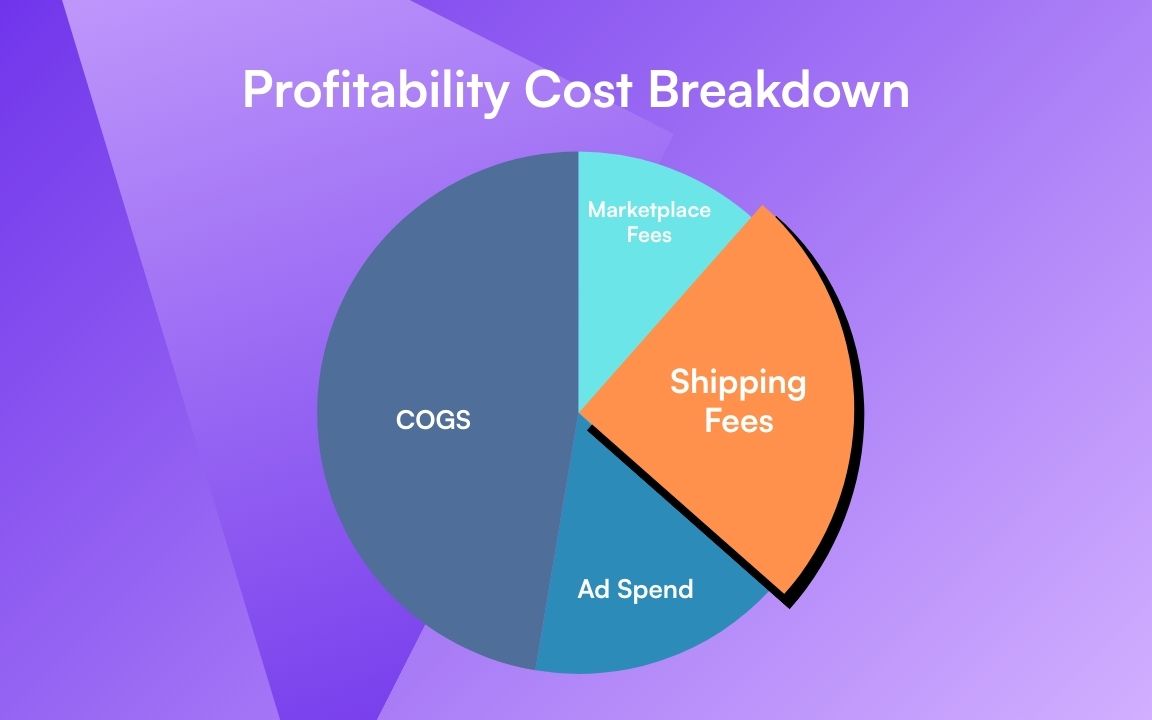
The core issue isn’t that teams don’t look at shipping costs. It’s that shipping is almost always looked at in isolation. With Conjura's new ShipStation connector all this changes. True landed shipping costs alongside, ad spend, marketplace fees and COGS to understands true product level profitability.
Shipping is never just a carrier fee. It’s one component in a broader cost structure that determines whether an order is profitable or not.
To understand the real cost of shipping, you need to look beyond the label price and consider how shipping interacts with the rest of the order economics. This includes fulfillment and handling costs, returns, and the commercial context in which the order was generated, particularly ad spend and marketplace fees.
When these elements are disconnected, teams end up asking the wrong questions:
The only way to answer the right questions is to calculate shipping costs in context, alongside every other cost tied to the order.
Shipping software helps you move orders. Shipping analytics helps you understand what those orders are really worth. Conjura exists to close the gap between execution and insight. Rather than replacing your shipping platform, it sits above your eCommerce, marketing, and fulfillment stack to connect shipping data with the rest of your commercial reality.
Where shipping tools focus on how orders are shipped, Conjura focuses on whether those orders are profitable once they’ve been shipped.
As brands scale, complexity compounds. New channels are added, ad spend increases, shipping rules multiply, and costs become harder to trace back to individual products.
Chef Supplies achieved a 115% increase in contribution profit thanks to Conjura's unified performance insights. Read the full case study here.
Conjura is built for this stage of growth. It’s designed for eCommerce businesses where:
This typically includes operations, eCommerce, merchandising, and finance teams working from the same dataset but asking very different questions.
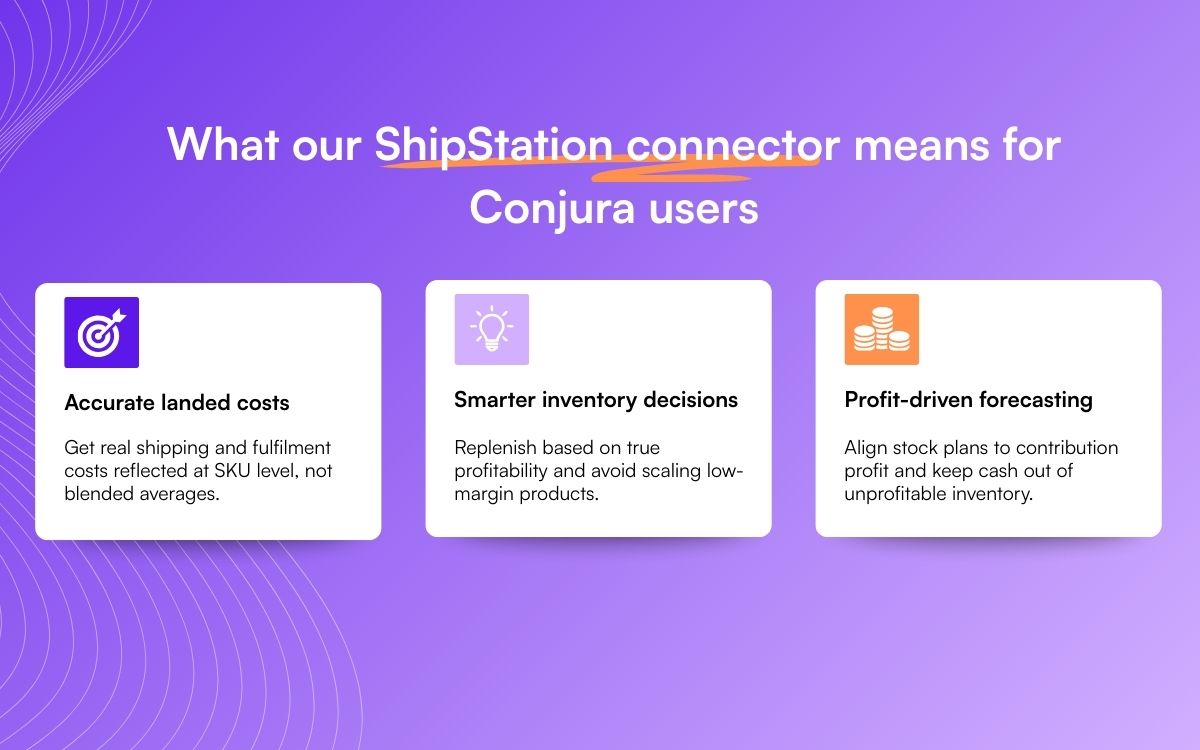
With Conjura’s ShipStation connector, shipping data becomes part of the profitability conversation rather than an after-the-fact expense. Instead of seeing shipping as a single line item, Conjura incorporates shipping fees directly into contribution profit calculations, alongside ad spend, COGS, returns, and marketplace fees. This makes it possible to understand the true landed cost of selling each product.
The impact of this is subtle but powerful. Shipping stops being something teams react to and starts becoming something they can plan around.
For example, brands can clearly see when:
This level of visibility is almost impossible to achieve when shipping data lives separately from marketing and product performance.
The real value of shipping analytics isn’t the data itself, it’s what teams can do with it. When shipping is analyzed in the context of profitability, brands can make smarter decisions across the business. Merchandising teams can adjust pricing or bundling strategies. eCommerce teams can refine free shipping thresholds. Operations teams can prioritize shipping methods that balance speed with margin protection.
Most importantly, everyone is working from the same numbers. Shipping decisions are no longer debated based on assumptions or averages, they’re grounded in contribution profit.
In 2026, shipping is no longer just an operational concern. It’s a strategic lever that affects growth, customer experience, and profitability in equal measure.
The best eCommerce shipping solutions, led by platforms like ShipStation, give brands the tools they need to execute fulfillment efficiently at scale. But execution alone isn’t enough. Without visibility into how shipping costs interact with product margins and ad spend, even the best shipping setup can quietly undermine profitability.
By connecting shipping data with the full cost structure of the business, Conjura enables teams to move from cost-focused shipping decisions to profit-led shipping strategies. For brands navigating rising costs and increasing complexity, that shift isn’t optional, it’s how profitable growth is sustained.
Discover the latest eCommerce guides, articles and tips to help your brand grow.
Book A Demo
Book a demo with one of our team to discover the power of Conjura and how it can transform your business.
Revenue Increase
"I’m a big fan of Conjura and there’s so much more for us to keep getting from it.”
Kayla Wilson, Marketing Director @ Furniturebox

Explore the
Platform


plans
Get Started
plans
plans



Explore
Conjura


Unlock eCommerce performance data and gain insights that drive profit.
