Wayflyer acquires Conjura to accelerate its AI product offering for small businesses (read more here)

eCommerce
Thursday, January 29, 2026
Discover the most important eCommerce KPIs to track in 2026. A profit-first guide to eCommerce metrics and KPIs that drive smarter growth.

Succesfully scaling an eCommerce brand in 2026 isn’t just about identifying new growth levers, it’s about protecting the ones you already have. Customer acquisition costs remain unpredictable. Marketplaces continue to squeeze margins. Paid media performance is harder to interpret with confidence. And most brands are now selling across a complex mix of owned stores, paid channels, organic traffic and third-party marketplaces.
In that environment, tracking eCommerce KPIs is no longer about reporting performance, it’s about achieving true profitability.
This guide breaks down the most important eCommerce KPIs to track in 2026, with a clear focus on the metrics that actually help brands make better decisions. Not vanity metrics. Not platform-specific numbers. But KPIs that connect revenue, cost and customer behaviour into a single, actionable view of growth.
At a basic level, eCommerce KPIs are measurable values that indicate how well your business is performing. They help you understand what’s working, what’s not, and where attention is needed. The challenge in 2026 isn’t a lack of KPIs, it’s too many disconnected ones. Most brands already track a handful of eCommerce metrics and KPIs across different tools: revenue in Shopify, sessions in GA4, ROAS in ad platforms, refunds in ERPs. Individually, each metric makes sense. Together, they often tell conflicting stories.
That’s why the most important eCommerce KPIs today share one common trait: context. Modern KPIs don’t just show outcomes. They explain why those outcomes are happening and whether they’re sustainable.
For years, eCommerce success was synonymous with growth. More traffic, more orders, more revenue. In 2026, that definition has matured. High sales numbers don’t automatically mean a healthy business. Growth that relies on heavy discounting, rising ad spend or low-quality customers can quickly become fragile. The brands that are winning now are the ones that understand quality of growth, not just volume.
That means measuring success across:
The KPIs below reflect this shift. They’re designed to help brands understand what’s really driving performance and where margin is quietly leaking away.
Rather than listing every possible metric, this 2026 top 10 KPIs for eCommerce list focuses on the numbers that consistently inform better decisions across marketing, merchandising and operations.
Conversion rate has always been a core eCommerce KPI, but in 2026, a single percentage is no longer enough.
Looking only at purchases divided by sessions hides too much of the customer journey. Conversion problems rarely happen at checkout alone, they usually begin earlier, when shoppers are browsing products, comparing options or encountering friction before committing.
At a high level, conversion rate is calculated as:
Conversion Rate = Purchases / Sessions
But the real insight comes from analysing how customers move through the funnel. Understanding where people drop off, whether at product view, add-to-cart or checkout, allows teams to diagnose issues with pricing, UX, delivery expectations or trust signals.
In 2026, strong conversion analysis isn’t about benchmarking against an industry average. It’s about identifying where friction exists and removing it with intent.
Average Order Value remains one of the most effective levers for increasing revenue without increasing traffic. What’s changed is how brands interpret it.
AOV shows how much customers spend per transaction, calculated as:
Average Order Value = Total Revenue / Number of Orders
On its own, AOV tells you whether customers are spending more or less. Paired with units per order, it reveals how that value is being created.
In 2026, brands that actively optimise AOV tend to focus on smarter merchandising rather than aggressive discounting. Bundles, cross-sells, free-shipping thresholds and subscriptions all increase order value while protecting margin.
The key is understanding whether higher AOV is driven by healthier buying behaviour or by incentives that quietly reduce profitability.
If there is one KPI that defines modern eCommerce analytics, it’s Contribution Profit.
Contribution profit measures what remains after all direct costs associated with selling a product are removed. This includes cost of goods sold, shipping, refunds, ad spend and marketplace fees - costs that traditional revenue metrics completely ignore.
The formula looks like this:
Contribution Profit = Net Revenue – COGS – Shipping – Refunds – Ad Spend – Direct Costs
This KPI matters because it reveals uncomfortable truths. Products that look like bestsellers can turn out to be unprofitable once paid media and returns are factored in. Channels that appear efficient on ROAS can quietly destroy margin at scale.
That’s why platforms like Conjura place such a strong emphasis on accurate, SKU-level contribution profit. It’s the only way to understand which products and channels genuinely deserve more investment.
While contribution profit shows absolute value, contribution margin shows efficiency.
Contribution margin expresses contribution profit as a percentage of net revenue:
Contribution Margin = Contribution Profit / Net Revenue
This KPI is essential for comparison. A product generating £10,000 in contribution profit might sound impressive, until you see it’s operating at a 6% margin, while another product delivers half the profit at three times the efficiency.
In 2026, contribution margin is critical for:
Tracking margin alongside profit ensures growth decisions are grounded in sustainability, not optimism.
Customer Lifetime Value remains one of the most important eCommerce KPIs to track, but how it’s used has evolved.
At its simplest, LTV estimates how much revenue a customer generates over the course of their relationship with your brand:
LTV = Average Order Value × Purchase Frequency × Customer Lifespan
In 2026, brands go further by analysing LTV through a profitability lens. They compare LTV against CAC, segment it by acquisition channel, and examine how different products influence long-term customer value.
This reveals which customers are worth acquiring aggressively, which channels deliver the highest-quality buyers, and where retention efforts have the greatest impact.
High-LTV customers are the foundation of sustainable growth, but only if that lifetime value is profitable.
Customer Acquisition Cost remains one of the most critical KPIs for eCommerce brands in 2026, largely because it’s one of the hardest to control.
CAC measures how much you spend, on average, to acquire a new customer. With paid media costs fluctuating and attribution becoming less reliable, many brands see CAC rise without fully understanding why. That’s what makes this metric so powerful when used correctly.
At its simplest, CAC is calculated as:
CAC = Total Marketing Spend / New Customers Acquired
On its own, CAC tells you whether acquisition is getting more expensive. But the real value comes from how you use it. In 2026, high-performing brands never look at CAC in isolation. Instead, they evaluate it alongside LTV, contribution profit and payback period to understand whether acquisition is creating long-term value or short-term risk.
A rising CAC isn’t always a red flag. It becomes a problem when customer quality and profitability don’t rise with it.
ROAS is still one of the most widely tracked eCommerce KPIs, but it’s also one of the most misleading when taken at face value.
Traditional ROAS measures how much revenue you generate for every unit of ad spend:
ROAS = Revenue from Ads / Cost of Ads
The problem is that ROAS stops at revenue. It doesn’t consider the costs that actually determine whether that revenue is worth having in the first place. Shipping, refunds, fulfilment, COGS and marketplace fees all sit outside the equation, which means ROAS can look healthy even when profit is declining.
That’s why more brands are moving toward Contribution ROAS in 2026. Instead of asking “how much revenue did ads drive?”, the question becomes “how much profit did ads generate once costs are accounted for?”
This shift is particularly important for brands with large product catalogues, multiple paid channels or high return rates. Tools like Conjura help close this gap by tying ad spend directly to SKU-level contribution profit, giving teams a far clearer picture of what’s actually worth scaling.
Revenue growth looks very different depending on who it comes from.
The split between new and existing customer revenue is one of the most underrated eCommerce KPIs to track, yet it reveals a huge amount about the health of your business. Brands that rely too heavily on new customer revenue often find themselves stuck on a treadmill of rising CAC and constant discounting.
Existing customers, on the other hand, tend to convert more easily, spend more per order and generate higher margins over time.
In 2026, leading brands pay close attention to:
A healthy balance doesn’t mean avoiding acquisition, it means ensuring retention and repeat purchasing are doing their share of the work.
Refund rate is often treated as a support or logistics metric, but in reality it’s a direct threat to profitability.
Refunds reduce net revenue, inflate perceived ROAS and quietly erode contribution margin. When brands only look at gross sales, refund-heavy products can appear successful even while they’re destroying profit behind the scenes.
Refund rate is typically calculated as:
Refunded Revenue / Gross Revenue
What makes this KPI especially important in 2026 is scale. As brands grow across channels and marketplaces, small increases in refund rate can translate into significant revenue at risk. High refund rates often point to deeper issues such as misleading ads, unclear product descriptions, sizing problems or mismatched customer expectations.
Tracking refund rate alongside contribution profit helps teams identify products that look like winners on the surface but are actually costing the business money.
Cart abandonment has always been a core eCommerce KPI, but how brands interpret it has changed.
At a basic level, cart abandonment rate shows how many shoppers add items to their cart but leave without completing checkout:
Cart Abandonment Rate = (Carts Created – Purchases) / Carts Created
In 2026, abandonment is rarely just a UX problem. It’s influenced by delivery expectations, shipping transparency, payment options, trust signals and overall brand perception. That means not every abandoned cart should be treated equally.
The most effective teams now layer profit context on top of abandonment data. Instead of trying to recover every lost cart, they focus their efforts where recovery actually makes financial sense, prioritising high-margin baskets, repeat customers or products with strong contribution margins.
Reducing abandonment is still important, but recovering the right abandonment is what drives profitable growth.
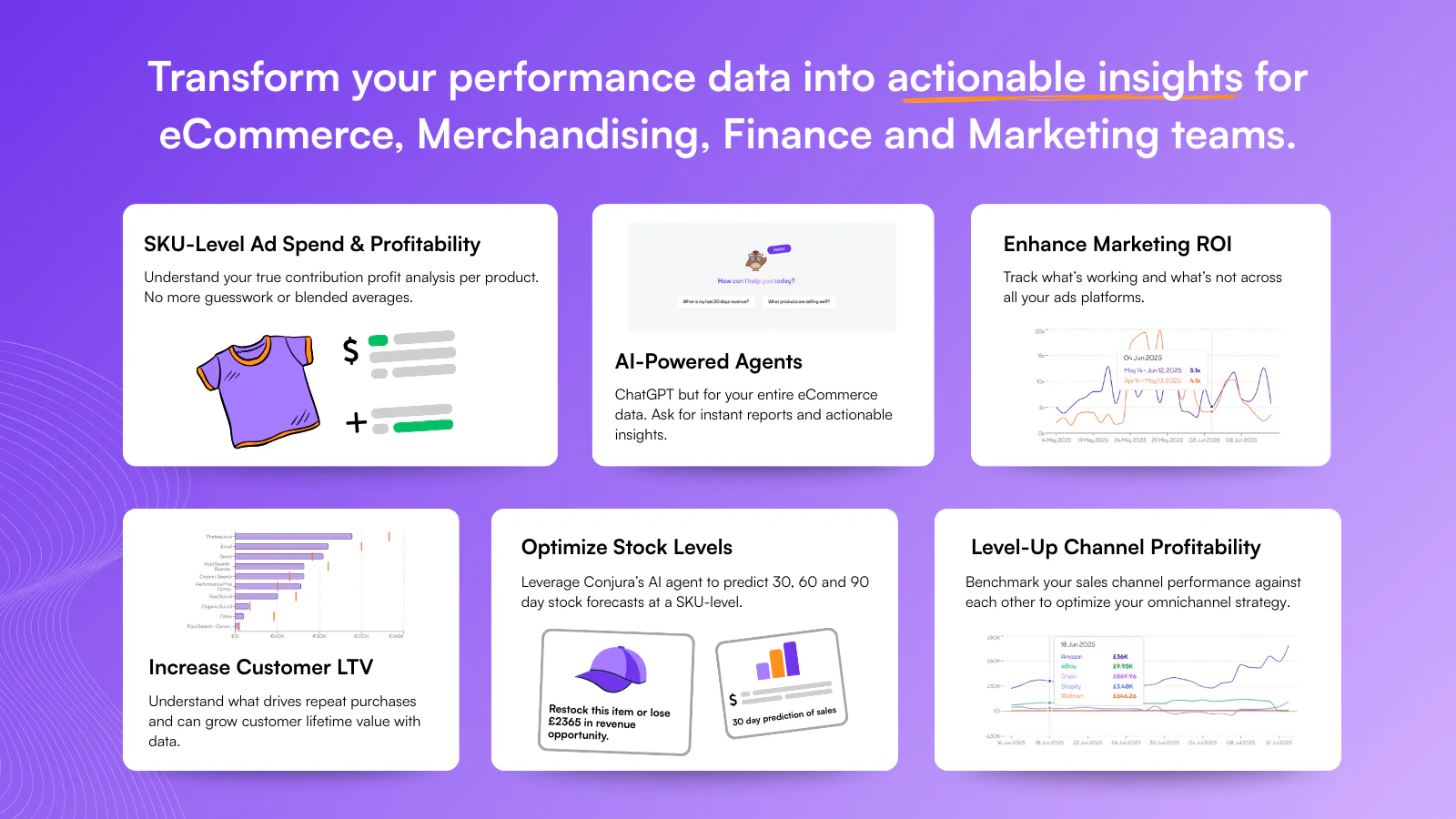
With so many eCommerce metrics available, the biggest challenge isn’t tracking KPIs, it’s choosing the right ones. A strong KPI framework in 2026 is built around decision-making, not reporting. The best KPIs help you clearly answer questions like:
If a metric doesn’t help answer those questions, it’s likely adding noise rather than value.
Most brands already have access to plenty of data from their store, analytics tools and ad platforms. The issue isn’t availability, it’s fragmentation. Different platforms use different definitions, different attribution models and different assumptions. Revenue looks great in one dashboard, ROAS looks strong in another, while profit quietly disappears in the background. That disconnect is why KPI tracking often feels confusing, time-consuming and reactive.
This is where Conjura comes into the picture
By bringing your store, marketing, customer and cost data into a single platform, Conjura allows brands to track the most important eCommerce KPIs with full profit context. Instead of guessing which products, channels or campaigns are driving growth, teams can see exactly where contribution profit is created, down to SKU level. In 2026, winning brands aren’t the ones tracking the most KPIs. They’re the ones tracking the right KPIs, with clarity and confidence.
Discover the latest eCommerce guides, articles and tips to help your brand grow.
Book A Demo
Book a demo with one of our team to discover the power of Conjura and how it can transform your business.
Revenue Increase
"I’m a big fan of Conjura and there’s so much more for us to keep getting from it.”
Kayla Wilson, Marketing Director @ Furniturebox

Explore the
Platform


plans
Get Started
plans
plans



Explore
Conjura


Unlock eCommerce performance data and gain insights that drive profit.
