Wayflyer acquires Conjura to accelerate its AI product offering for small businesses (read more here)

eCommerce
Thursday, February 19, 2026
Master eCommerce inventory management with best practices and top tools. Learn how to align stock and use AI forecasting to drive profitable growth.

Inventory used to be an operations problem. Now? It’s a growth problem. A marketing problem. A cash flow problem. And for most eCommerce brands, it’s the difference between scaling profitably and scaling into chaos. Stockouts kill momentum. Overstock drains cash. Paid media drives unpredictable demand spikes. Marketplaces complicate allocation. And somewhere in the middle, operations, merchandising, and marketing teams are trying to align around spreadsheets that were already outdated yesterday.
Modern eCommerce inventory management is no longer just about knowing what’s in the warehouse. It’s about knowing:
In this guide, we’ll break down eCommerce inventory management best practices and the best ecommerce inventory management software tools available today and explain how analytics platforms like Conjura complement your stack to turn inventory from a cost center into a profit driver.
At its core, eCommerce inventory management is the process of tracking, controlling, forecasting, and optimizing stock across online sales channels.
That includes:
When brands operate across multiple channels like Shopify, Amazon, marketplaces, eBay, this becomes multi-channel eCommerce inventory management. That’s where things get complicated.
Because now inventory must stay synchronized across:
The margin for error shrinks quickly.
A single misalignment can result in:
Inventory management is no longer just a warehouse function. It’s an integrated, cross-functional growth lever.
Most brands think about inventory in terms of availability. Smart brands think about it in terms of profitability.
Here’s why.
Inventory is cash.
Overstock means:
Understock means:
The goal isn’t “never run out.” It’s optimal stock positioning based on demand and margin.
Revenue doesn’t equal profit. To truly understand the impact of inventory decisions, you need to look at contribution profit, calculated as:
Net Revenue – COGS – Shipping Costs – Refunds – Ad Spend – Amazon Fees – Custom Costs
Inventory decisions directly impact:
And when you layer in marketing spend at a SKU level, profitability can shift dramatically.
For example:
Without proper eCommerce inventory tracking tied to profitability metrics, you risk restocking the wrong products.
This is where most brands fall apart.
Picture this:
Inventory and marketing must operate from the same dataset.
This requires:
Inventory management software alone doesn’t solve this. It tells you what you have, not what you should promote.
Now let’s move from theory to execution.
These best practices apply whether you’re a $2M DTC brand or a $50M multi-channel operator.
If your inventory updates once per day, you’re already behind.
Modern eCommerce inventory tracking should include:
Key metrics to monitor consistently include:
Sell-through rate is calculated as:
Units Sold / (Units Sold + Units Remaining on Hand)
But tracking these metrics in isolation isn’t enough.
You need to understand:
That’s where analytics layered on top of inventory systems becomes essential.
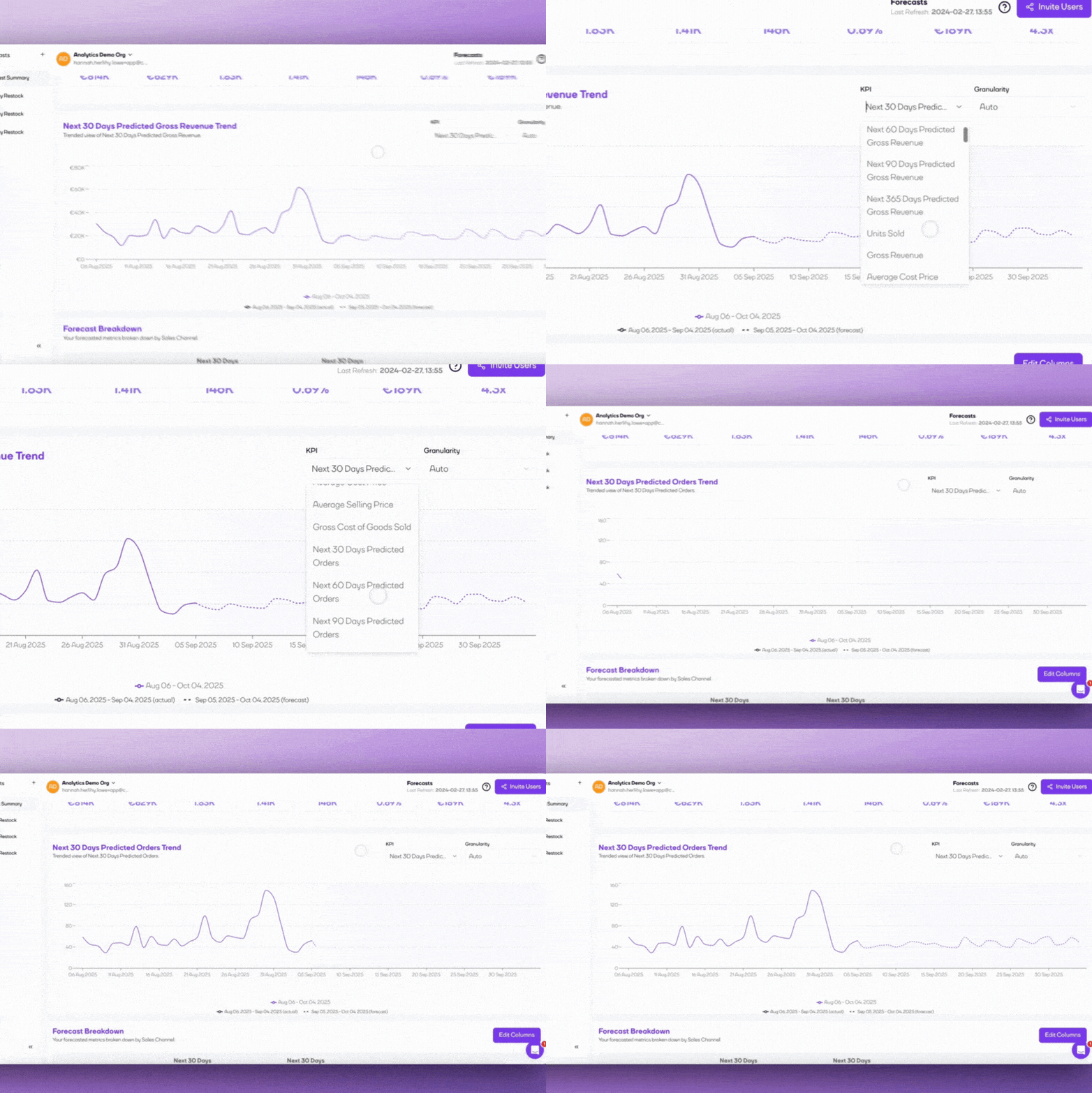
Many brands forecast at the category level. That’s a mistake. Why?
Because performance varies dramatically at SKU level.
Factors influencing SKU-level demand include:
AI-driven forecasting is becoming a competitive advantage here.
Conjura’s AI forecasting, for example, uses:
To predict SKU-level demand with approximately 90% accuracy over 30 days. That kind of precision transforms inventory planning from reactive to proactive.
Instead of asking “What sold last year?” You can ask “What is likely to sell over the next 30, 60, or 90 days, based on current signals?”
That’s a completely different level of decision-making.
This should be non-negotiable.
Before scaling ads on any SKU, teams should verify:
Accurate SKU-level ad spend attribution is critical here.
When you know exactly how much ad spend is driving each product, you can:
Marketing teams should never operate independently from inventory visibility. The brands that scale profitably treat inventory and paid media as two sides of the same engine.
A product selling quickly isn’t automatically a winner.
If a SKU has:
It may be:
Inventory management decisions should always consider:
The goal is not just fast-moving inventory it's profitable inventory velocity.
Operations, marketing, and merchandising should not be working from separate reports.
Modern systems should allow:
When teams operate from a shared source of truth:
Without cross-functional visibility, inventory becomes reactive instead of strategic.
Let’s look at the tools powering modern inventory management, where they fall short, and how to bridge the gap between stock control and profit-driven growth.
There’s no shortage of eCommerce inventory management software on the market. But the right solution depends on your operational complexity, channel mix, and growth stage. In no particular order here are five of the best eCommerce inventory management software tools brands commonly use.
Best for: Marketplace-heavy brands
Linnworks is particularly strong for Amazon and marketplace operators who need centralized stock control and order routing.
Strengths:
Limitations:
For marketplace sellers, it’s a powerful multi-channel eCommerce inventory management solution but like most inventory systems, it doesn’t show you which SKUs are truly profitable after ad spend.
Best for: Multi-warehouse, omnichannel operations
Cin7 is designed for complexity. If you’re managing retail, wholesale, and eCommerce simultaneously, this platform provides robust supply chain visibility.
Strengths:
Limitations:
Cin7 excels in supply chain control but marketing alignment often requires additional analytics layers.
Best for: Forecasting-first teams
Inventory Planner focuses heavily on demand forecasting and replenishment planning.
Strengths:
Limitations:
It’s helpful for operational planning but it doesn’t factor in paid media signals or true profitability drivers.
Best for: Enterprise eCommerce brands
NetSuite is a full ERP solution covering finance, inventory, operations, and reporting.
Strengths:
Limitations:
For larger brands, it’s a backbone system but it still doesn’t bridge the marketing-profitability gap.
Best for: Small-to-mid-sized DTC brands
QuickBooks Commerce is a solid entry-level solution for brands needing basic eCommerce inventory tracking.
Strengths:
Limitations:
It’s strong operationally, but once brands scale paid media aggressively, they often need deeper performance visibility.
Here’s the unfortunate truth, inventory management systems tell you what you have, they don’t tell you what you should prioritize.
They can show:
But they don’t answer questions like:
For example, Conjura tracks:
These are insights inventory software alone simply doesn’t provide.
Without this layer, brands often:
Inventory control without profitability intelligence is incomplete.
Conjura is not an inventory management system. It’s the profitability intelligence layer that sits on top of your eCommerce, marketing, marketplace, and inventory performance data turning it into a strategic decision-making powerhouse.
Here’s how.
Most platforms estimate product profitability. Conjura calculates contribution profit using:
Net Revenue – Gross Cost of Goods Sold – Shipping Costs – Refunds – Ad Spend – Amazon Fees – Custom Costs
And crucially ad spend is attributed accurately at a SKU level
This allows operations and merchandising teams to:
Inventory decisions become profit decisions.
Traditional forecasting looks backward. AI forecasting looks forward.
Conjura’s AI forecasting uses:
To predict SKU-level demand with ~90% accuracy over 30 days
This helps teams:
Forecasting becomes dynamic instead of reactive.
Inventory dashboards can be overwhelming. Luckily for you Owly AI changes that.
Owly AI acts as an embedded analytics agent that allows teams to:
Imagine asking:
Instead of pulling multiple reports, Owly AI surfaces the answer immediately.
For operations teams, that means:
Inventory doesn’t live in one place anymore.
Your stock is spread across:
But most inventory systems view these in isolation. Conjura brings them together. By combining eCommerce, marketplace, marketing, and ERP data into one unified dataset, Conjura enables:
See SKU performance across:
This helps you answer:
Instead of splitting stock based on guesswork, you allocate based on profitability.
With region-level performance visibility, teams can:
If one region is outperforming, you can proactively shift inventory before stockouts occur, rather than reacting after revenue is lost.
When connected to ERP and warehouse data, Conjura supports:
This allows operations teams to:
Inventory allocation becomes data-driven, not reactive.
Conjura enables:
Operations can have:
Marketing can have:
Finance can have:
All from the same unified dataset!
With omnichannel intelligence layered on top of your ecommerce inventory management software, you don’t just know what stock you have.
You know:
That’s the difference between managing inventory and managing growth.
eCommerce inventory management is evolving.
It’s no longer enough to:
The future is:
Inventory systems manage stock.
Analytics platforms like Conjura ensure that stock drives profit.
If you want to:
Then it’s time to move beyond basic eCommerce inventory tracking because profitable growth doesn’t come from selling more.
It comes from stocking and scaling the right products.
Discover the latest eCommerce guides, articles and tips to help your brand grow.
Book A Demo
Book a demo with one of our team to discover the power of Conjura and how it can transform your business.
Revenue Increase
"I’m a big fan of Conjura and there’s so much more for us to keep getting from it.”
Kayla Wilson, Marketing Director @ Furniturebox

Explore the
Platform


plans
Get Started
plans
plans


Explore
Conjura


Unlock eCommerce performance data and gain insights that drive profit.
