Wayflyer acquires Conjura to accelerate its AI product offering for small businesses (read more here)

eCommerce
Thursday, January 8, 2026
Metorik pricing in 2026 explained. See costs, features, limitations, and the best alternatives for WooCommerce analytics as your store scales.
If you run a WooCommerce store, you’ve probably heard of Metorik. In 2026, pricing pressure is real: margins are tighter, ad costs are volatile, and “good enough” reporting rarely stays good enough for long.
This guide breaks down Metorik Pricing in 2026, what you get for the money, where it shines for Metorik WooCommerce users, and when it’s worth considering other WooCommerce Analytics options, especially if you want deeper profit and marketing insight across channels.
Metorik is an analytics and email tool built primarily for WooCommerce Analytics, with support for Shopify as well. It’s designed to turn messy store data into clean dashboards and reports with strong segmentation so you can slice performance by product, customer type, country, coupon usage, and a lot more.
It also includes optional email capabilities, such as abandoned cart and automation workflows, built on top of the same store data you’re analysing, so reporting and activation live in one place.
If your current “reporting stack” is WooCommerce + spreadsheets + vibes, Metorik is certainly an upgrade.
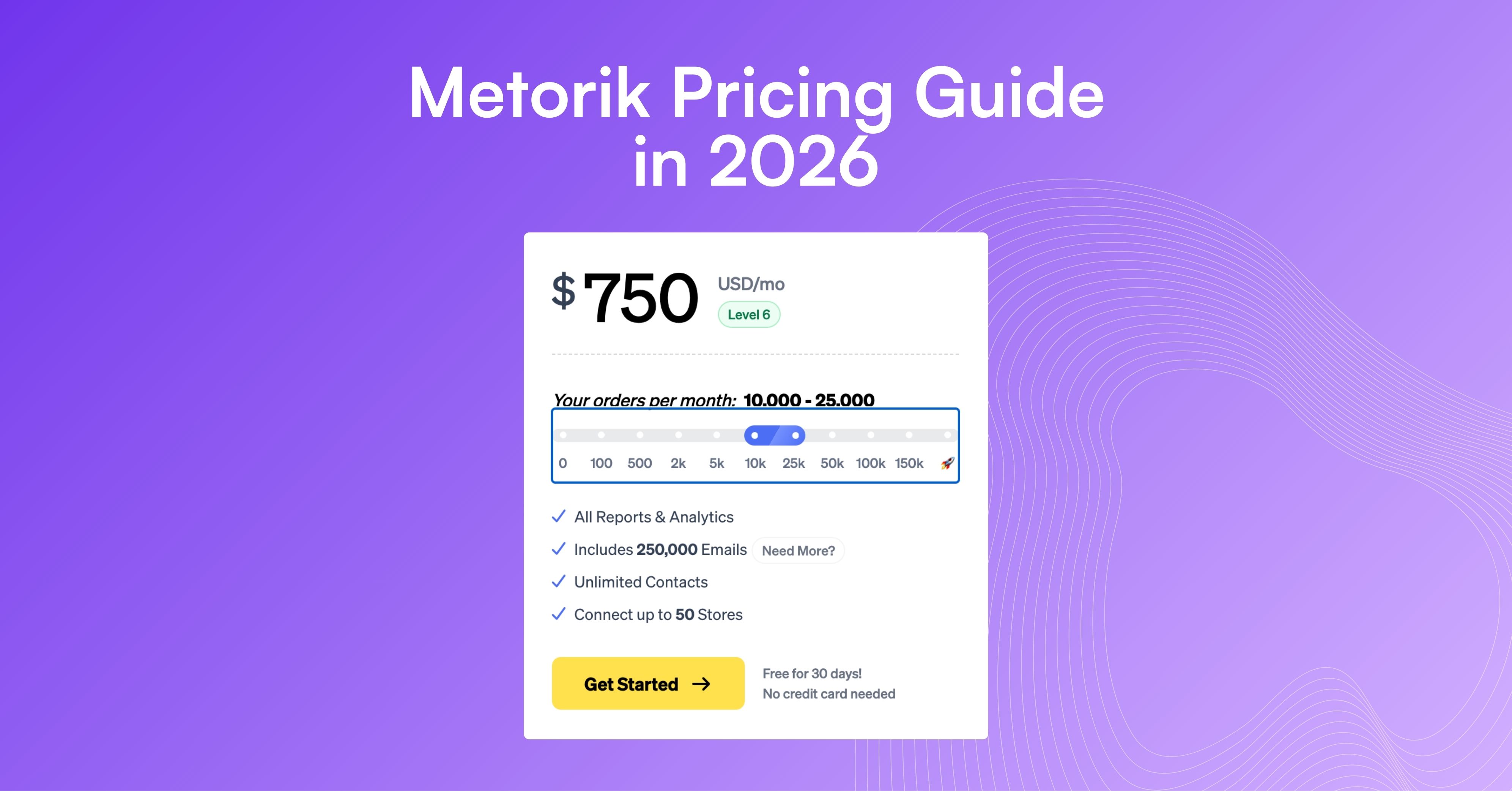
Metorik’s pricing scales based on your average monthly orders.
Metorik uses an average of your last 3 months of orders (up to your billing day) to estimate your “monthly orders,” which then determines your pricing tier.
If you manage multiple stores, Metorik can group them under one company and price you based on the combined monthly order volume (with some rules depending on platform).
To make Metorik pricing more tangible, let’s look at how costs typically scale for WooCommerce stores based on monthly order volume. Metorik prices plans according to your average number of WooCommerce orders per month, usually calculated using a rolling multi-month average.
*Pricing based on their pricing page, January 2026
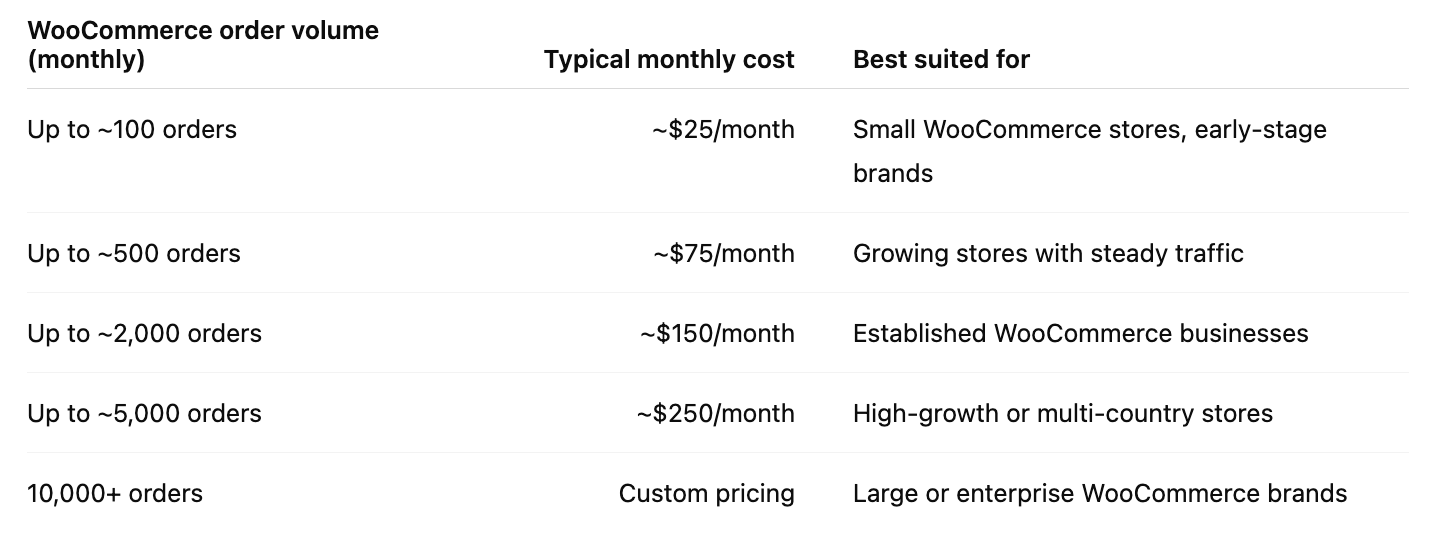
All tiers include access to Metorik’s reporting, segmentation, automation tools, and core WooCommerce Analytics features. The main variable is how much data Metorik needs to process as your store scales.
For WooCommerce businesses running multiple sites (for example, regional storefronts or brand extensions), Metorik can group stores under a single account and calculate pricing based on the combined order volume across those WooCommerce stores.
Metorik pricing works well for WooCommerce brands in early and mid-growth stages, but as order volume increases, costs rise automatically. That makes it important to regularly reassess whether the insights you’re getting justify the higher monthly spend, especially once profitability and marketing efficiency become the main focus.
Metorik positions pricing as “all features included” across plans, just scaled by volume. Here are the key capabilities that matter most for WooCommerce Analytics teams in 2026.
Metorik provides dashboards and a reporting suite for performance tracking, including customer reports and subscription reporting (for WooCommerce Subscriptions).
This is one of Metorik’s biggest strengths: build customer cohorts, track retention, and measure LTV by cohort over time.
If subscriptions are a major part of your revenue, Metorik offers subscription KPIs like MRR, churn, LTV, and cohorts, specifically for WooCommerce Subscriptions.
Metorik supports cost tracking and profit reporting (including COGS at product/variation level).
Metorik supports integrations like Google Analytics, plus ad platforms such as Google Ads, Meta Ads, TikTok Ads, Microsoft Ads, and more - useful if you care about WooCommerce Analytics Google style reporting and attribution signals.
Metorik is a capable analytics tool for WooCommerce reporting, but as brands scale, its limitations become more visible. These gaps tend to show up at the exact moment teams move from reviewing performance to actively optimizing profit. This is where Conjura is built to operate.
Below are the key areas where Metorik falls short and how Conjura approaches those problems differently.
Metorik can report on revenue, costs, and profit at a high level, but it struggles with the most commercially important question for scaling eCommerce teams:
“Which products are actually profitable after marketing spend?”
In Metorik:
This creates blind spots, especially for brands running Google Shopping, Meta catalog ads, remarketing, or multi-product landing flows.
Conjura is purpose-built to solve this. It accurately attributes marketing spend down to individual SKUs and calculates true contribution profit per product, factoring in revenue, COGS, refunds, shipping, and ad spend. That allows teams to make product and marketing decisions based on actual margin, not proxy metrics like ROAS.
Metorik is primarily store-centric. It works well if WooCommerce is your main (or only) channel, but modern eCommerce operations are rarely that simple.
As soon as brands expand into:
Metorik can start to feel siloed. Insights remain fragmented across tools, and profitability becomes difficult to assess holistically.
Conjura is designed to unify store data, marketing data, and customer behavior into a single profit-led view. This allows teams across marketing, merchandising, and finance to work from the same numbers and prioritize actions that improve overall business performance, not just channel metrics.
Read our latest case study on how we helped Discounted Sunglasses increase their contribution margin across multiple marketplaces.
Metorik does a good job of telling you what happened. What it doesn’t do particularly well is tell you what to do next.
Most insights in Metorik still require:
That’s manageable at small scale, but as teams grow leaner and decision speed becomes critical, it turns into friction.
Conjura goes further by surfacing built-in product and profitability actions. Instead of just showing performance, it highlights:
This turns analytics from a reporting function into a decision engine.
Metorik pricing is directly tied to order volume. While that keeps entry costs low, it also means brands can end up paying significantly more without unlocking more advanced insight as they scale.
At higher volumes, many teams find themselves asking:
Conjura’s value scales with decision complexity, not just volume. As brands grow, the platform becomes more useful, not just more expensive, because it’s designed to answer increasingly difficult questions around profit, efficiency, and scale.
If Metorik pricing doesn’t fit, or you want broader eCommerce analytics beyond WooCommerce, here are strong alternatives.
Conjura is built to turn performance data into actions that drive profit, especially at the product/SKU level, by unifying store + marketing + analytics data into one platform.
Where Conjura stands out:
If your main question is “Which products should we scale, cut, or fix to improve profit?” Conjura is built for that job.
If budget is tight and you mainly need traffic + conversion tracking, GA4 can cover a lot, especially when paired with a clean WooCommerce implementation. It’s also the most direct answer to “WooCommerce Analytics Google.”
Downside: GA4 won’t natively give you clean profit metrics, SKU-level true contribution, or operational actions without a lot of stitching.
Triple Whale is strong in marketing attribution workflows and is widely used by performance marketing teams. Conjura’s own review notes Triple Whale’s strengths—and where brands can feel boxed in if they want deeper SKU-level profitability and product insights.
Polar is often chosen by teams that want “all data in one place” with high flexibility and customization, including access to underlying data. (Great if you have analysts who want to build.)
For many Woo stores, yes, especially if you want a clean reporting layer, strong segmentation, cohort analysis, and subscription analytics without building your own BI stack. Metorik pricing is relatively transparent, starts low, and scales with order volume.
But if you’ve outgrown “store reporting” and you’re trying to run a profit-first operation, where marketing spend, cost data, and SKU-level decisions drive every meeting, then it’s worth comparing Metorik against platforms designed specifically for profit-led eCommerce analytics, like Conjura.
Discover the latest eCommerce guides, articles and tips to help your brand grow.
Book A Demo
Book a demo with one of our team to discover the power of Conjura and how it can transform your business.
Revenue Increase
"I’m a big fan of Conjura and there’s so much more for us to keep getting from it.”
Kayla Wilson, Marketing Director @ Furniturebox

Explore the
Platform


plans
Get Started
plans
plans



Explore
Conjura


Unlock eCommerce performance data and gain insights that drive profit.
