Wayflyer acquires Conjura to accelerate its AI product offering for small businesses (read more here)

eCommerce
Thursday, January 15, 2026
Learn what agentic commerce is, how Shopify’s Universal Commerce Protocol works, and how brands can sell directly through AI shopping agents.
For years, eCommerce innovation followed a predictable arc. First came better storefronts. Then smarter ads. Then personalization, recommendations, and chatbots designed to help customers decide what to buy.
Now we’re entering the next phase.
Instead of just assisting with discovery, AI is starting to take action (quite literally). Customers can ask AI search engines what to buy, have it compare options, add items to a cart, apply discounts, select shipping, and complete checkout, often without ever visiting a traditional storefront.
This is now known as Agentic Commerce, a buzzword I’m sure you’ll become very familiar with in 2026!
Agentic commerce fundamentally changes how buying happens online. It collapses discovery, decision-making, and transaction into a single AI-driven flow. And it’s forcing platforms, merchants, and analytics tools to rethink how commerce infrastructure works behind the scenes.
At the center of this shift is Shopify’s newly announced Universal Commerce Protocol (UCP), a foundational layer designed to let AI agents transact reliably across merchants, platforms, and surfaces.
Agentic commerce refers to eCommerce experiences where AI agents don’t just recommend products, they execute commerce actions on behalf of a shopper.
That includes:
In most cases, the shopper still remains “in the loop.” They might confirm a purchase, approve substitutions, or choose between options. But the heavy lifting - the browsing, filtering, and operational steps - is handled by an AI agent. This is the key difference between agentic commerce and earlier forms of conversational commerce.
Agentic commerce isn’t appearing out of nowhere. It’s the result of three trends converging at once:
Shoppers are increasingly starting product research inside AI interfaces instead of search engines or marketplaces. Asking AI feels faster than opening ten tabs and brutally scouring the web for the best deal or right fit.
Modern AI systems don’t just generate text. They can break goals into steps, choose tools, and handle conditional logic (“if this is out of stock, choose the next best option”).
Until recently, there was no standardized way for AI agents to securely and reliably interact with real commerce systems - catalogs, checkout, payments, orders, and fulfillment.
That’s where agentic commerce protocols come into play to bridge that gap.
Without shared standards, agentic commerce simply doesn’t scale.
Imagine a world where:
That’s the N×N integration problem and it’s a non-starter.
To make agentic commerce viable at scale, AI agents and commerce platforms need a common language, a standardized way to understand what a merchant can actually do. That includes clearly defining which actions a merchant supports, how checkout is handled, what policies apply, and how orders are confirmed, modified, or refunded.
This is exactly what an agentic commerce protocol is designed to solve. Rather than dictating who sells or where customers shop, protocols define how systems communicate, transact, and stay in sync behind the scenes. And in eCommerce, no platform is better positioned to lead this effort than Shopify, given its central role in powering catalogs, checkout, payments, and order management at global scale.
Shopify’s Universal Commerce Protocol (UCP) is an open, extensible standard designed to enable agentic commerce at scale.
It was developed to allow AI agents across search, chat, and conversational interfaces to interact directly with merchant commerce systems in a consistent, reliable way.
In practical terms, UCP lets AI platforms “understand” how to:
…without merchants having to build custom integrations for every AI surface.
Shopify built the Universal Commerce Protocol because it already sits at the center of a massive share of global eCommerce infrastructure. Today, Shopify powers core commerce systems like product catalogs, checkout, payments, order management, and fulfillment logic for millions of merchants.
As agentic commerce began to emerge, Shopify faced a clear and unavoidable question: how do we let AI platforms transact on behalf of shoppers without breaking trust, security, or merchant control? The Universal Commerce Protocol is Shopify’s answer, providing a standardized, secure way for AI agents to interact with commerce systems while keeping merchants firmly in charge of their business logic.
UCP is built around a capabilities-based model.
Instead of assuming every merchant supports the same flows, UCP allows merchants to expose what they can do, such as:
AI agents can then:
This design is critical for real-world commerce, where edge cases are the norm, not the exception.
One of the most important aspects of UCP is support for embedded checkout experiences.
Rather than kicking shoppers out to a separate site, AI agents can present checkout directly within the conversational interface, while still using Shopify’s battle-tested checkout logic underneath.
That means:
For merchants, it also means they remain fully in control of pricing, taxes, fraud rules, and payment logic.
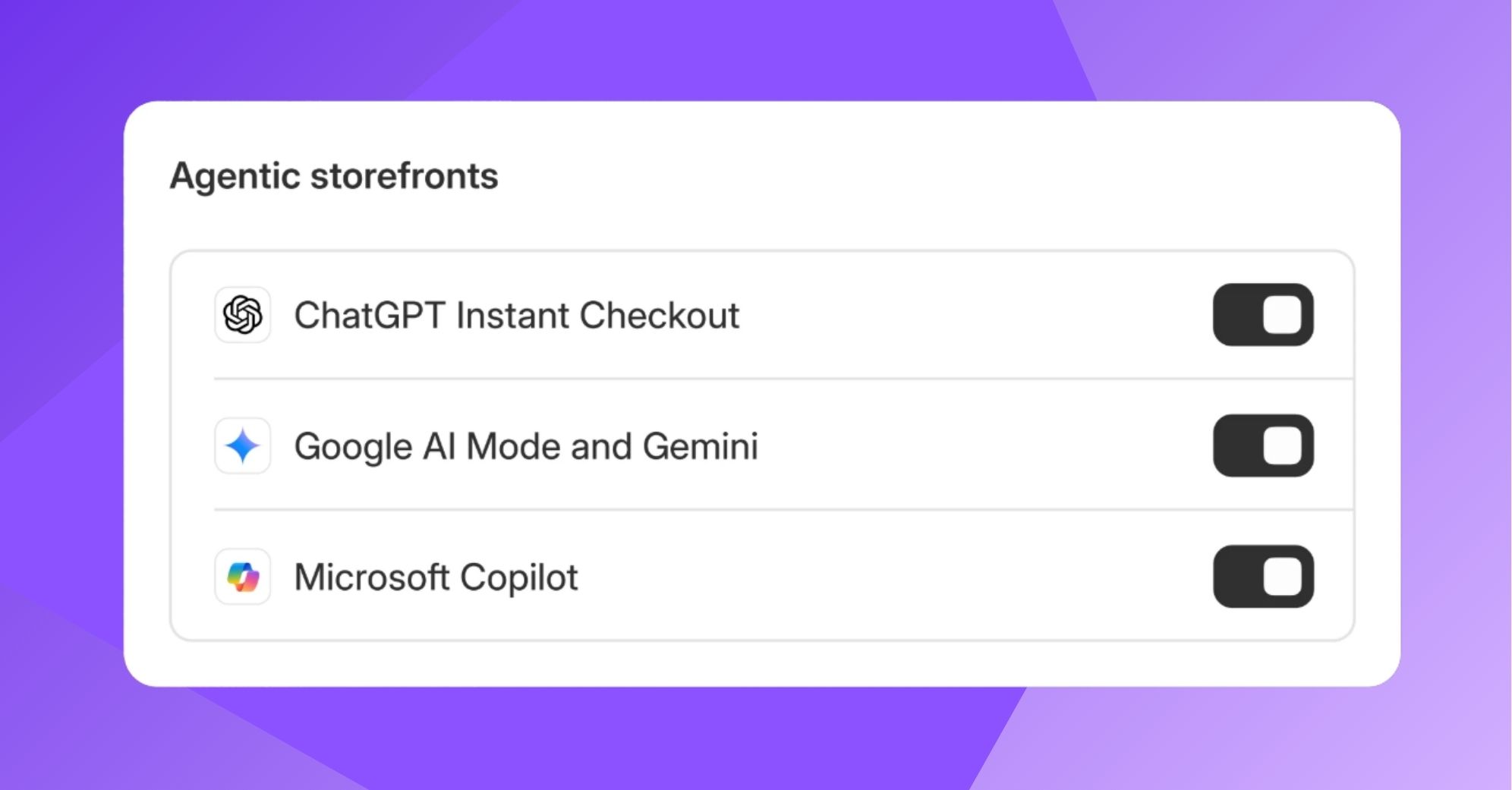
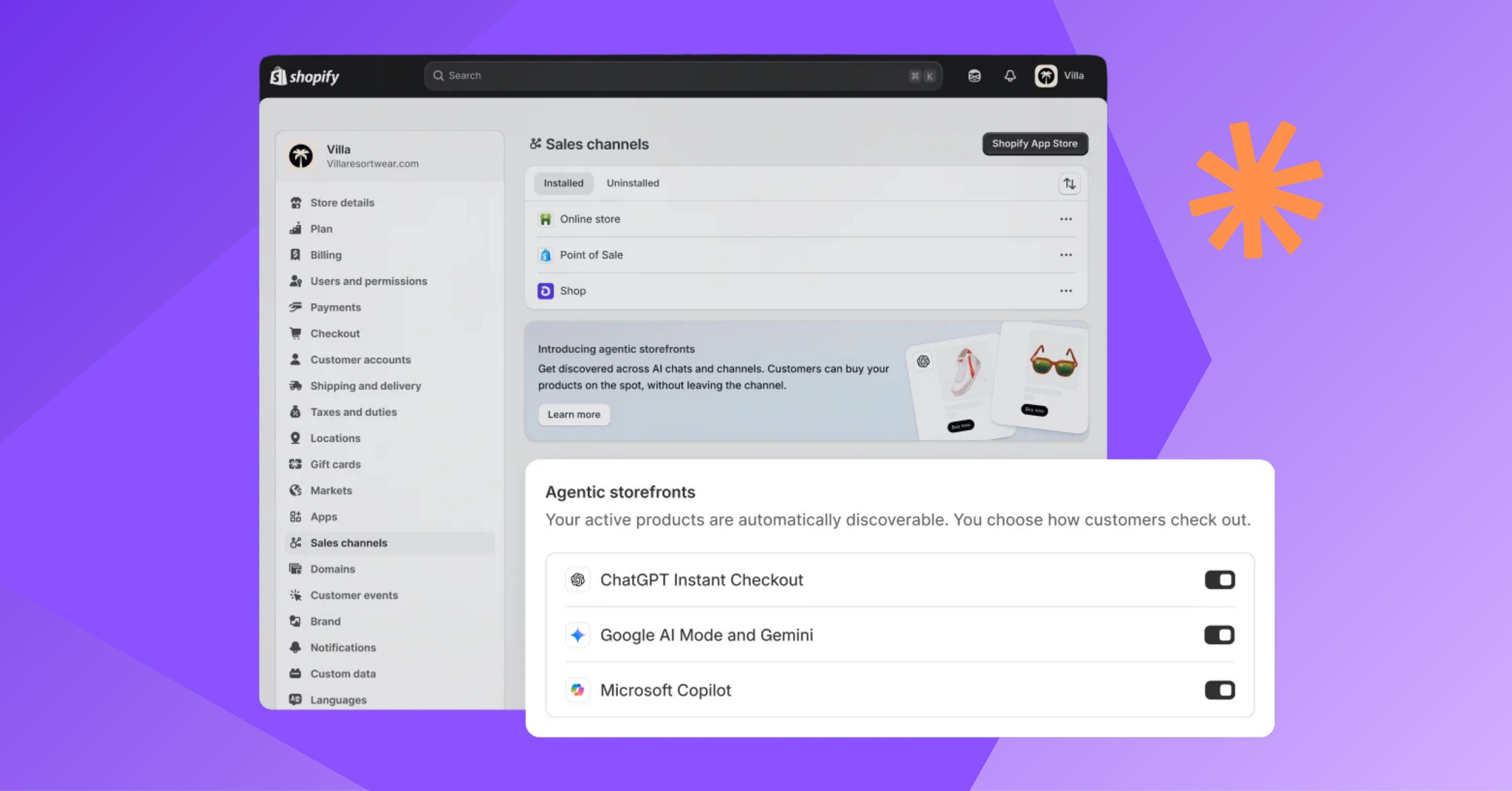
Important note: Shopify’s agentic storefronts are currently in early access (as of 15th January 2026), so they aren’t available for every store yet. If you’re eligible, the setting will appear in your Shopify admin. Either way, it’s rolling out, so it’s worth getting ready now.
What this does: your products can be purchased directly inside that AI channel.
If you toggle it off: your products can still be discoverable, but shoppers will be redirected to your online store to complete checkout instead of buying directly in the AI storefront.
If you don’t want everything available for direct AI checkout, you can unpublish specific products from the agentic storefront using the product’s sales channel availability controls. Unpublishing stops direct purchase in the AI storefront, but the product can still remain discoverable.
Want to hide a product from AI discovery too? Shopify lists a few options, including adding a custom seo.hidden metafield or setting the product as Unlisted, but note this can also remove the product from sitemaps and search engine visibility, so use carefully.
Shopify even notes you can filter orders for a specific AI channel, for example, orders placed from ChatGPT Instant Checkout (when available for your store).
Agentic commerce introduces a paradox.
Externally, AI agents make buying easier for customers. Internally, decision-making becomes harder for brands. That’s where Conjura comes in.
Conjura is built around a simple idea: every growth decision should be grounded in profit, not guesswork.
As agentic commerce accelerates, brands will need to answer questions like:
Traditional analytics tools struggle here because they stop at performance.
If agentic commerce means AI agents buying on behalf of customers, Owly AI is the agent that helps your team keep up.
Owly AI is Conjura’s embedded analytics assistant. It lets eCommerce teams:
What is agentic commerce in simple terms?
Agentic commerce is when AI doesn’t just recommend products, it completes purchases on behalf of shoppers.
How is agentic commerce different from conversational commerce?
Conversational commerce helps customers decide. Agentic commerce helps them buy.
What role does Shopify play in agentic commerce?
Shopify provides the underlying commerce infrastructure, including the Universal Commerce Protocol, to let AI agents transact securely and consistently.
Do brands lose control when selling through AI agents?
No. Merchants remain the merchant of record and retain control over pricing, policies, and checkout logic.
How should brands measure success in agentic commerce?
By focusing on profitability, inventory health, and SKU-level performance, not just clicks or revenue.
Discover the latest eCommerce guides, articles and tips to help your brand grow.
Book A Demo
Book a demo with one of our team to discover the power of Conjura and how it can transform your business.
Revenue Increase
"I’m a big fan of Conjura and there’s so much more for us to keep getting from it.”
Kayla Wilson, Marketing Director @ Furniturebox

Explore the
Platform


plans
Get Started
plans
plans



Explore
Conjura


Unlock eCommerce performance data and gain insights that drive profit.
